
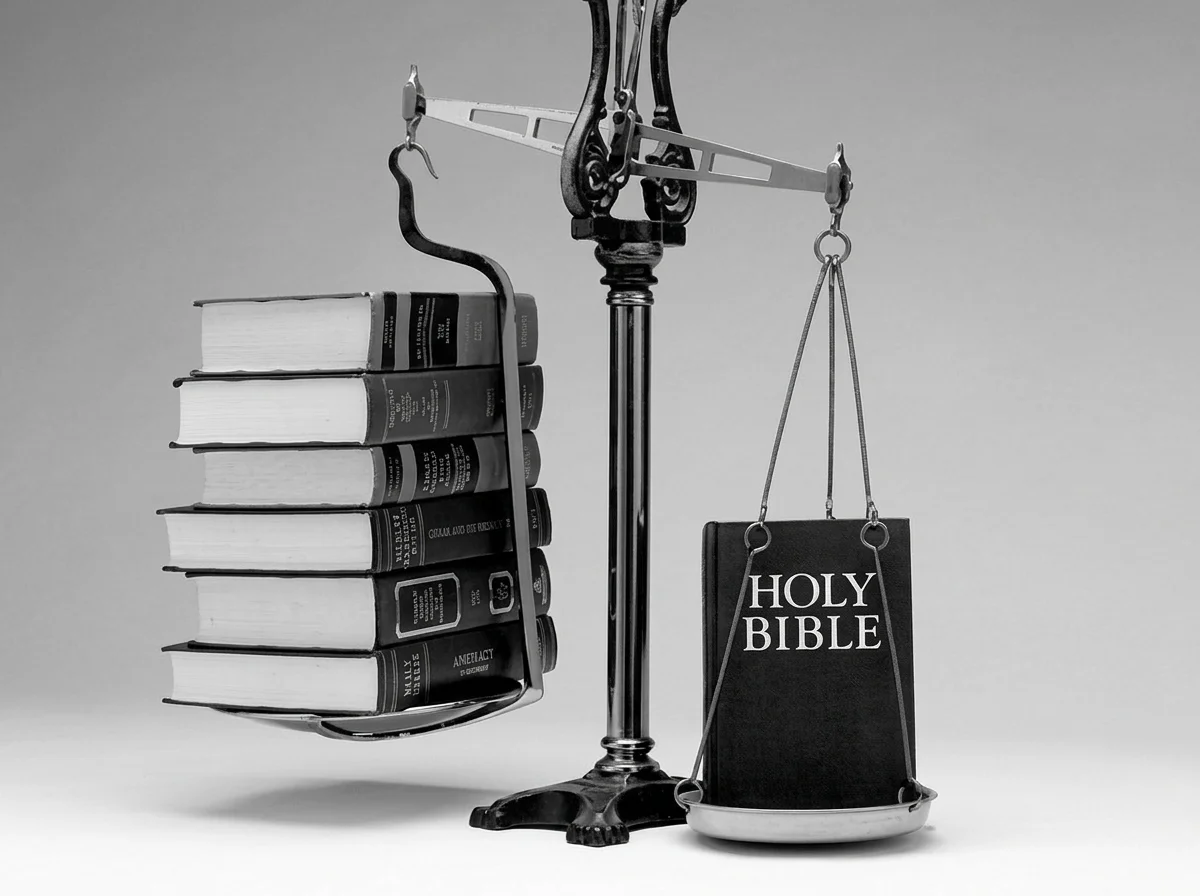
“God is not a god of disorder, but of Peace.”
Religious principle: Law & order
1 Corinthians 14:33
In a culture increasingly marked by civic unrest, rising crime, and intense debates over national sovereignty, Christian voters are called to look beyond partisan talking points. We must ground our civic engagement in the enduring truths of scripture.
To ensure human flourishing, prevent tyranny, and maintain a peaceful society where the Gospel can go forth unhindered, God established the institution of civil government. As Christian voters, upholding law and order, supporting the courageous peacemakers who protect our communities, and maintaining just, secure national borders are primary biblical responsibilities that must guide our vote.
The Bible does not leave us guessing about what happens when a society rejects divine order and the rule of law. The book of Judges provides a vivid, historical warning of a culture that completely abandoned foundational truth:
“In those days there was no king of Israel. Everyone did what was right in his own eyes.”
Judges 21:25
When a society replaces objective, God-given moral laws with subjective, individual desires—doing "what is right in their own eyes"—the result is not absolute freedom. The result is total chaos.
Without a shared moral standard anchored in God's word, justice becomes weaponized by whoever holds political power. Security evaporates, institutional trust erodes, and the most vulnerable in society (the unborn, the elderly, and the poor) are the first to be exploited. Ultimately, a society that rejects godly restraint collapses under the weight of its own lawlessness, often inviting tyranny as a desperate remedy for the chaos it created.
RIghteous Law & Order
-
Civil government and the Church are two distinct institutions with separate responsibilities. In the Old Testament, the offices of King (civil) and Priest (religious) were strictly separated. In the New Testament, Jesus explicitly outlined this boundary:
“Render therefore to Caesar the things that are Caesar’s, and to God the things that are God’s.” Matthew 22:21
The Boundary: The state has the authority to collect taxes and maintain civic order, but it has NO authority over the human soul, the doctrines of the Church, or the worship of God.
Voter Application: Candidates must respect religious liberty. The government oversteps its boundary when it mandates how churches operate, forces ministries to violate their statements of faith, or penalizes believers for living out their convictions in the public square.
-
The family was instituted in Genesis long before the existence of civil governments or nations. God gave the responsibility of raising, educating, and disciplining children directly to parents—not to the state.
“And these words that I command you today shall be on your heart. You shall teach them diligently to your children...” Deuteronomy 6:6–7
The Boundary: The state’s role is to protect the family unit, not to replace it or act as the primary parent.
Voter Application: The government oversteps its boundary when it interferes with parental rights, hides information regarding a child’s health or identity from parents, or mandates secular, ideological curricula that contradict the family's religious training.
-
According to scripture, the government’s primary moral purpose is to act as a shield for the innocent and a sword against the wicked.
“For rulers are not a terror to good conduct, but to bad... For he is the servant of God, an avenger who carries out God's wrath on the wrongdoer.” — Romans 13:3–4
The Boundary: Government authority is valid only as long as it aligns with God’s definitions of good and evil. A government has no right to label evil as "good" and good as "evil" (Isaiah 5:20).
Voter Application: When the state begins punishing the righteous (such as restricting free speech, peaceful assembly, or the preaching of the Gospel) while coddling or excusing violent lawlessness, it has flipped its divine mandate. Christians should vote for leaders who promise to uphold true, equal justice under the law.
-
Scripture recognizes the right to private property and warns heavily against governments that use excessive taxation to confiscate the wealth of their citizens to build massive bureaucratic empires.
The Biblical Warning: In 1 Samuel 8:11–18, the prophet Samuel explicitly warned the people of Israel that an unrestrained, centralized government would endlessly take their sons, their daughters, their fields, and a massive percentage of their livestock and grain until the people cried out under the oppressive weight of the state.
The Boundary: Property rights are protected by the Commandment, “You shall not steal” (Exodus 20:15), which applies to governments just as much as it applies to individuals.
Voter Application: The state oversteps its boundary when it enacts confiscatory tax rates, stifles economic freedom, or takes property unjustly. Christians should support leaders who advocate for fiscal responsibility, limited government spending, and the protection of private property rights.
-
Nations and their geographical boundaries are not accidental human social constructs; they are part of God's providential design for mankind to prevent the concentration of global tyrannical power
“And he made from one man every nation of mankind to live on all the face of the earth, having determined allotted periods and the boundaries of their dwelling place.” Acts 17:26
The Boundary: A government has a divinely appointed boundary of jurisdiction. A nation has a legal and moral obligation to define, defend, and control its borders to preserve order and security for its citizens.
Voter Application: The state oversteps its boundary when it abdicates its responsibility to secure its borders, allowing unchecked, unvetted crossings. Christians should support leaders who prioritize national sovereignty and fund robust physical and legal border security.
-
In the Old Testament, the “guest” was expected to respect the religious, moral, and civil laws of the community. They were not permitted to establish separate, lawless enclaves within the nation.
“The foreigner residing among you must be treated as your native-born. Love them as yourself, for you were foreigners in Egypt. I am the Lord your God.” Leviticus 19:34
The Boundary: Immigrants are welcomed to contribute to and join the community, but they must adapt to the foundational legal and cultural framework of the nation they are entering.
Voter Application: Candidates should support an orderly, legal immigration process that requires background checks, values national security, and ensures that those entering are prepared to respect and uphold the host nation's laws and constitutional principles.
-
The foundational rule for a believer facing an ungodly mandate is explicitly stated by the apostles when they were legally ordered by the ruling council to stop preaching the Gospel:
“But Peter and the apostles answered, ‘We must obey God rather than men.’” Acts 5:29
The Boundary: If a law requires you to do what God forbids (e.g., forcing you to lie, worship an idol, or harm an innocent person) or forbids you from doing what God commands (e.g., sharing the Gospel, gathering for worship, or teaching your children scriptural truth), you cannot comply.
The Reality: This is not an endorsement of lawless rebellion or violent anarchy. It is a quiet, resolute allegiance to the King of Kings. When the Hebrew midwives refused Pharaoh's command to execute newborn boys (Exodus 1), or when Daniel continued to pray despite the king's decree (Daniel 6), they accepted the earthly risks because their fear of God outweighed their fear of the state.